Semi-dry screed is not a new material. It is a different way of placing the same cement-sand mortar: far less water, and a machine that moves it.
That small difference rewrites site economics. A floor that took a week with six men is laid in a day by three.
What it is
Cement-sand mortar at a very low water content — the consistency of damp sand, not batter. Squeezed in the hand it holds together as a ball and sheds no water. Polypropylene fibre is dispersed through the mass, doing the job steel mesh does in a traditional screed.
It is mixed outside the flat in a pneumatic mortar pump, blown through a hose to the pour, then levelled and power-floated with a disc trowel.
Why it does not crack
Counter-intuitively, less water cracks less. Most cracking in a traditional screed is drying shrinkage, not structural: the water added beyond what the cement needs to hydrate evaporates, the volume shrinks and the surface cracks. Cement needs roughly a quarter of its weight in water; everything above that in a wet screed was added to make placing easier, not to make the mortar stronger.
Semi-dry gives the cement close to what it needs and no more: less shrinkage, higher density, no mesh required in ordinary residential work.
The machine — the advantage nobody sees from outside
The pump sits outside the building. Only a hose enters the flat. That means no sand carried up the stairs, no mixing dust inside, and no water leaking to the floor below — which alone decides the choice in an occupied building. Vertical reach runs to tens of metres and horizontal reach to several times that, depending on the model and compressor; take the numbers from the manufacturer's data for the unit you buy, not from a general figure.
Against a traditional screed
| Item | Traditional screed | Semi-dry screed |
|---|---|---|
| Material transport | Carried by hand | Pumped through a hose |
| Mixing location | Usually inside the flat | Outside the building |
| Site cleanliness | Dust, water, residue | One hose enters |
| Excess water | High, to ease placing | Minimum for hydration |
| Drying shrinkage | High — surface cracking | Low |
| Reinforcement | Steel mesh, usually | Dispersed fibre |
| Foot traffic | Two to three days | About a day |
| Daily output | Tens of m² with a large crew | Several times that with a smaller one |
| Mix consistency | Varies by worker and day | Set by the machine |
These are directions, not commitments: real output changes with height, distance, layout and crew experience.
Before the next layer
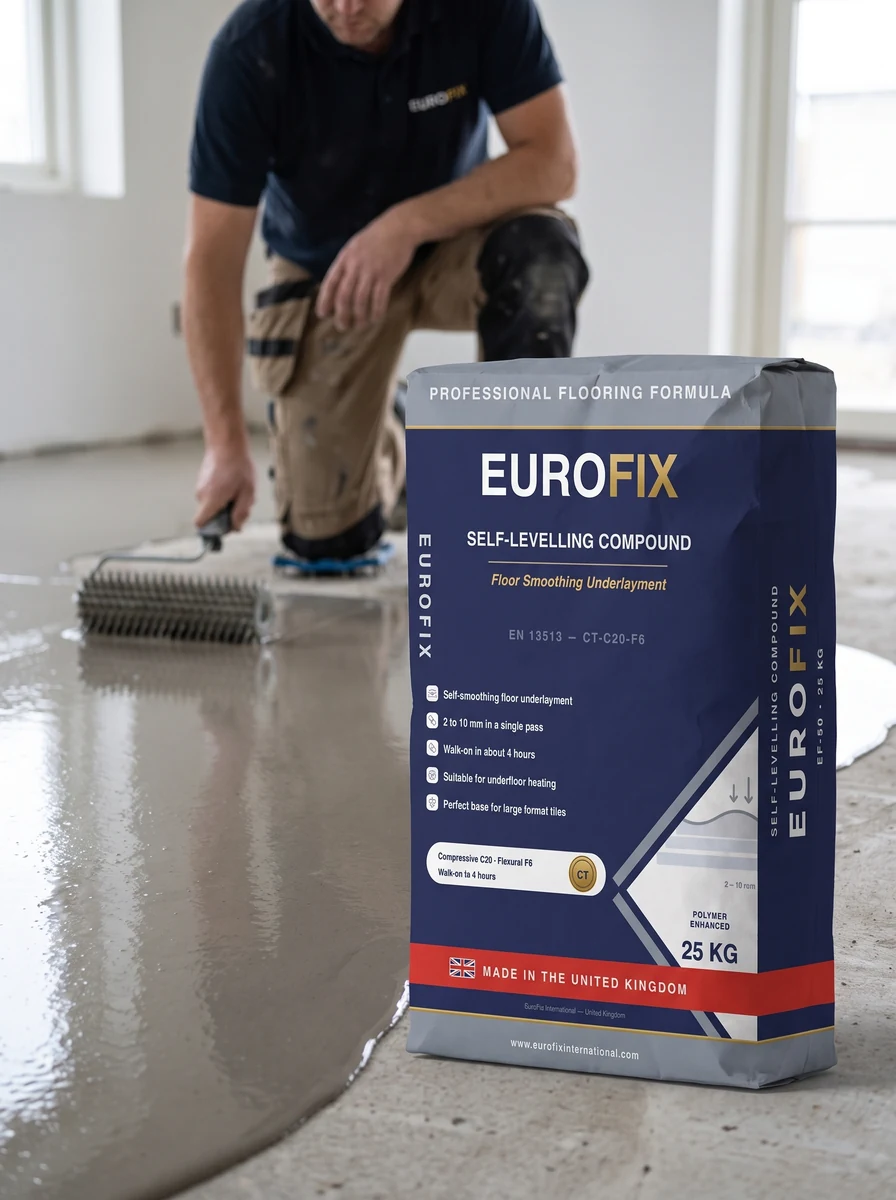
"Walkable" is not "ready to finish". Tile is more forgiving because cement adhesive breathes; timber, vinyl and epoxy must wait on a residual-moisture reading. Where a finer flatness is needed, run a thin self-levelling compound over the cured screed. Prime in either case — a semi-dry surface is porous and will pull water out of the adhesive. See our guide to surface preparation and primers.
As a business
Syria is rebuilding, and every one of those floors will be laid somehow. A crew with a machine competes on two things price alone cannot answer: speed, which lets you commit to dates others cannot, and cleanliness, which in an occupied building or a turnkey handover argues better than a discount per square metre.
You need a pneumatic mortar pump, a disc power float, a laser level, three trained people, and a stable source of clean graded sand. That last one is the real constraint here — ungraded or inconsistent sand blocks the hose and ruins flatness, and it will break the technique long before the machine does. Fix the sand supply before buying the equipment.
We publish no equipment prices or payback periods: they move with the model, the exchange rate and your workload, and any number written today misleads within a month. Send us your project and we will work it through on today's figures.