When render peels or tiles let go, the material usually gets the blame. In most cases the material was right and the surface was never prepared. Preparation comes down to a single question.
The only question: absorbent, or smooth?
These are opposite problems with opposite cures, and applying one to the other makes things worse.
1) Absorbent — the problem: it steals the mix water
Block, brick, porous concrete and gypsum pull water out fast. Cement needs that water to hydrate and gain strength; drawn away too early, the mortar dries before it cures — friable, prone to peeling and hairline cracking.
Cure: a penetrating acrylic primer — it soaks into the pores, consolidates them and regulates absorption.
2) Smooth — the problem: nothing to grip
Formwork concrete is closed and slick, sometimes with release-oil residue. Mortar finds no pores and sags off.
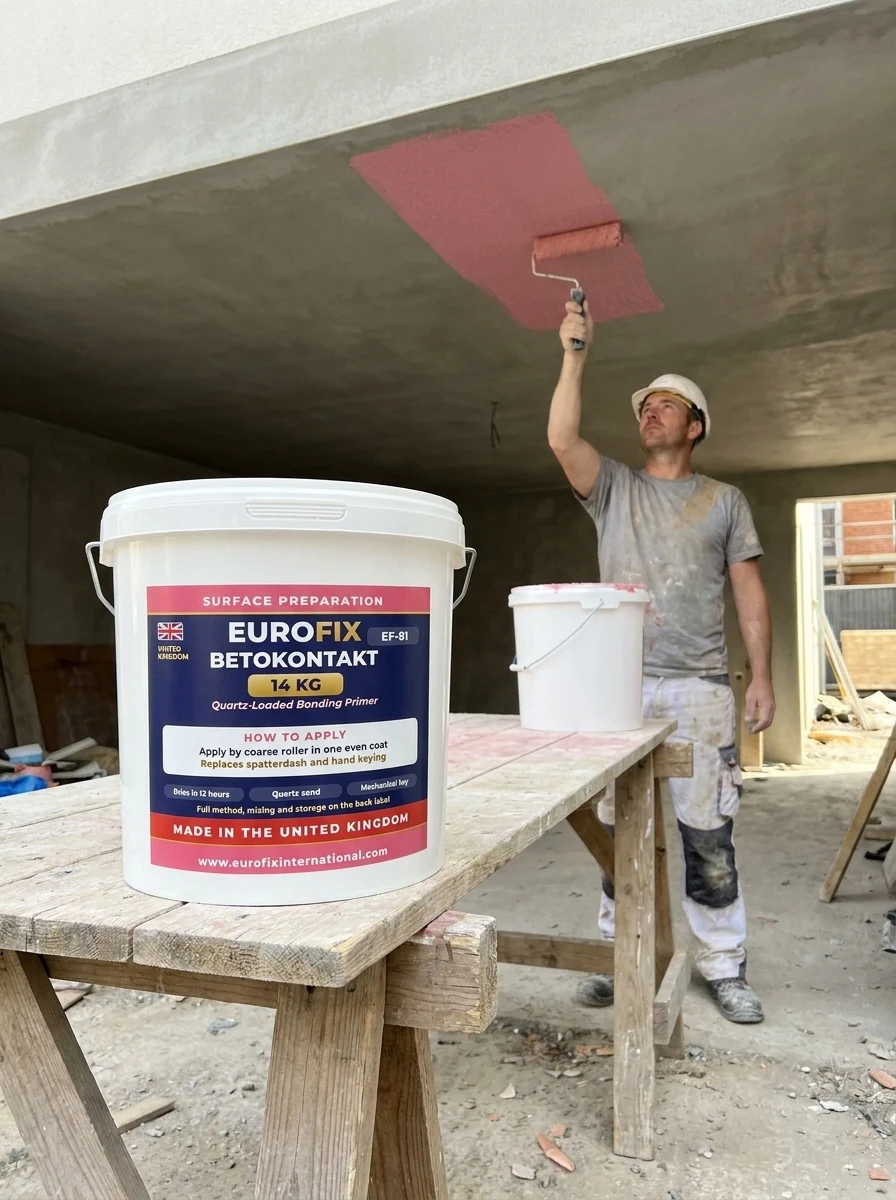
Cure: Betokontakt — a quartz-filled contact primer that creates an artificial key for mechanical grip. Usually pink so you can see it was applied.
The water test — thirty seconds
- Vanishes instantly, leaves a pale patch → absorbent → penetrating primer.
- Beads and sits on top → smooth → Betokontakt.
- Slow, moderate absorption → a thinned penetrating primer is usually enough.
More reliable than judging by eye: plenty of surfaces look rough but are closed, and vice versa.
The common error: swapping them
- Betokontakt on an absorbent surface is drunk into the pores and disappears — money spent, absorption unchanged.
- Penetrating primer on smooth concrete has no pores to enter and can leave a slick film that makes adhesion worse than bare.
The right sequence
- Clean — dust, oil and loose material. A loose old layer takes your work down with it.
- Repair — fill large defects first; primer does not fix a failing substrate.
- The right primer, per the water test.
- Wait. The step everyone skips. Rendering over damp primer traps moisture and weakens the bond. Read the drying time on the pack and respect it.
- Render, then level — see mortars & levelling.
Special cases
- Gypsum: very absorbent and moisture-sensitive. Penetrating primer is mandatory; no heavy cementitious layers over it in wet areas.
- Bathrooms: a primer is not waterproofing. One prepares the surface, the other stops water — two different jobs.
- Façades: daily thermal movement means a rigid material will crack however well prepared.
- Old painted surface: if the paint is sound, abrade it then Betokontakt; if it flakes, remove it entirely — no primer rescues a loose layer.
In short
Primer is not the line item to cut. A bag of adhesive on an unprepared surface is money thrown away, because the failure does not show on the day — it shows months later, when the repair costs many times the primer.
Compare primers in construction chemicals, or start from the full catalogue.