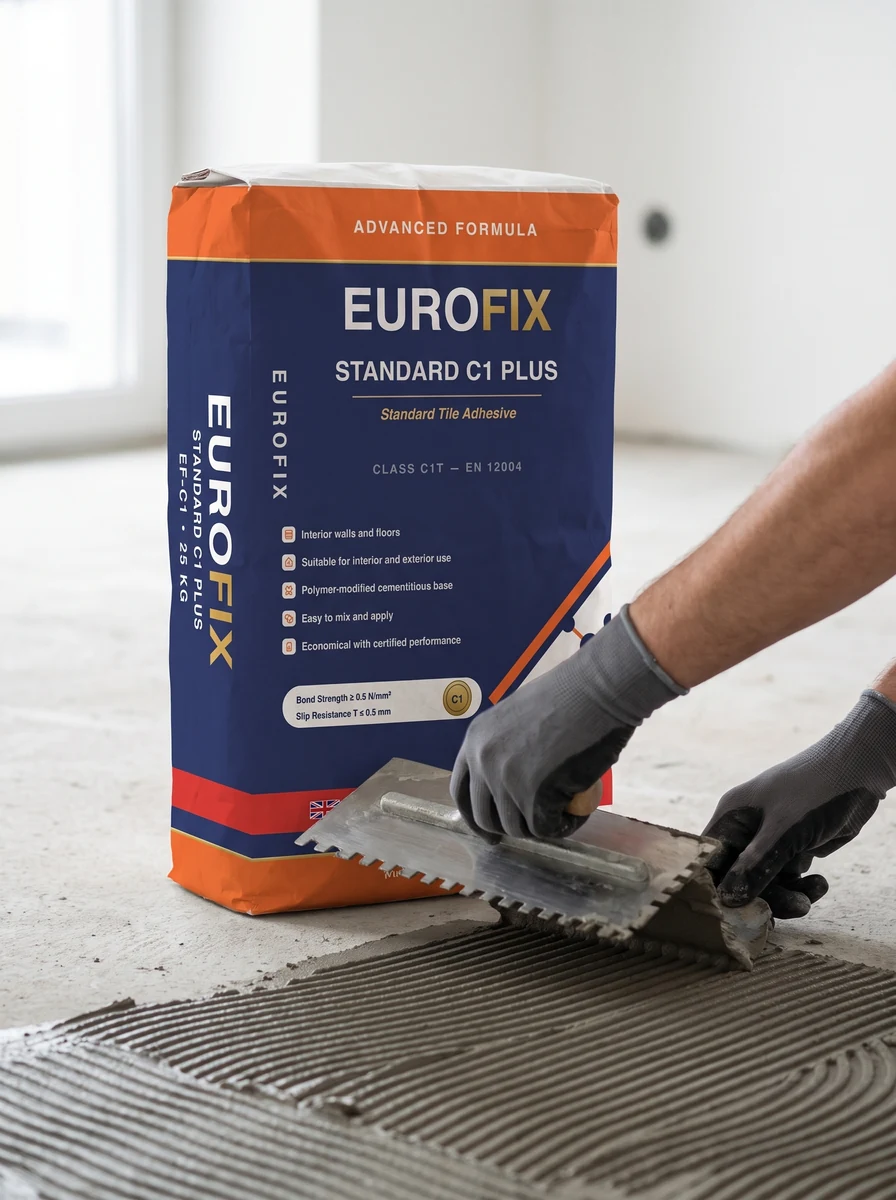
The commonest mistake is not buying a poor adhesive; it is buying an excellent one in the wrong place — or paying for a property the job does not need. A practical comparison of the range on Umranex.
First: decoding the letters
A code like C2TE S1 is a readable specification under EN 12004:
- C — cementitious.
- 1 or 2 — bond strength: class 1 ≥ 0.5 N/mm², class 2 ≥ 1.0 — twice as strong.
- T — slip resistance: the tile does not slide down a wall.
- E — extended open time.
- S1 — deformable: absorbs substrate movement instead of passing it to the tile.
Second: the comparison
| Product | Class | Consumption | Working time | Per 25 kg bag |
|---|---|---|---|---|
| Thin-Set M10 | thin-bed masonry | 2–3 kg/m² | 20 min | $4.19 |
| Standard C1 Plus | C1T | 3–5 kg/m² | 20–30 min | $4.89 |
| Flexible Premium C2 Plus | C2TE S1 | 3.5–6 kg/m² | 30 min | $9.79 |
| Pool & Spa S1 | C2TE S1 | 4–6 kg/m² | 30–45 min | $11.89 |
| S2 White Flex | C2TE S1 (white) | 3.5–6 kg/m² | 30 min | $13.29 |
Prices shown are the launch offer for visitors; contractors and distributors see lower prices once registered.
Third: which one, and why
Thin-Set M10 is a masonry mortar for AAC blocks at 2–3 mm instead of a 10–20 mm traditional bed — a fifth of the consumption and a straighter wall. Not for tiling.
Standard C1 Plus suits absorbent interior ceramic on level walls and floors. Not for porcelain, not above 40 cm, not outdoors.
Flexible Premium C2 Plus is the default for most of today's tile: porcelain, large formats, balconies, over underfloor heating.
Pool & Spa S1 is for permanent immersion. Double-buttering is mandatory and the pool is filled after 7–14 days.
S2 White Flex exists because marble and pale stone are semi-translucent: a grey adhesive shows through as dark patches that cannot be fixed without removing the stone. For pale stone, white is not a luxury.
Fourth: the three-question rule
- Porcelain, or over 40 cm? → at least class 2.
- Does the substrate move thermally? → S1.
- Is the stone pale or translucent? → white.
Three "no"s and C1 Plus is enough — there is no reason to pay the difference.
Browse tile adhesives, or read why a sand-cement bed fails under large formats.