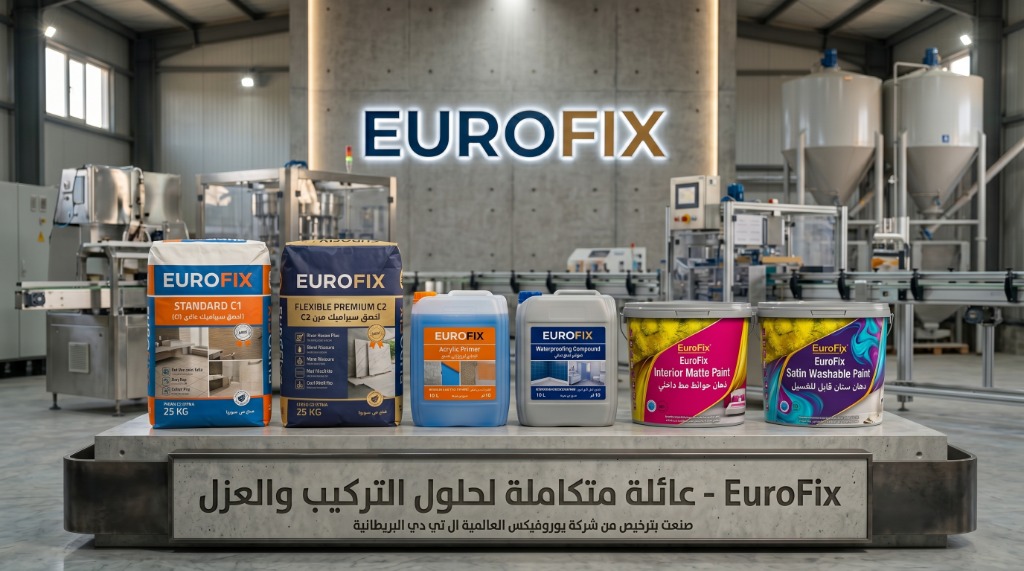
Syria's building-materials market is in a broad reconstruction phase, and with it demand has risen for finishing materials whose performance can be trusted — not on brand name alone, but on a written technical specification you can read and refer back to.
Who is EuroFix International?
EuroFix International is a UK brand specialising in construction chemicals: tile and porcelain adhesives, waterproofing compounds, external thermal insulation systems, repair mortars, self-levelling compounds, and interior and exterior paints.
You can review the company, its full range and its datasheets directly on its official site: eurofixinternational.com, which also has a section dedicated to the Syrian market.
How is Umranex related to EuroFix?
Plainly stated: Umranex is the digital channel that presents and sells EuroFix products inside Syria. We are not an independent assessor of these products and do not present ourselves as one. Our role is to put the catalogue, pricing and specifications in one place a merchant or contractor can order from.
That is exactly why this article links to the manufacturer's own site: so you read the technical data at source, not on a sales page.
What does "conforms to EN standards" mean?
European Norms define how a product is tested and the minimum performance it must reach. The ones that matter in finishing work:
- EN 12004 — tile adhesives. The code tells you a lot: C for cementitious, 1 or 2 for bond strength, T for slip resistance, E for extended open time, S1 for deformability.
- EN 998-2 — masonry mortars, including AAC block adhesives.
- EN 1504-3 — structural concrete repair mortars.
- EN 13813 — floor screed materials.
- EN 14891 — waterproofing membranes under tiles.
- EN 13279-1 — gypsum binders and plasters.
The practical benefit: when you see C2TE S1 on a bag, you already know it suits porcelain and large formats and tolerates thermal movement — without relying on marketing copy.
Why this matters in Syria specifically
Common practice on many sites is still mixing cement and sand on site to fix tiles. That is an old method whose result changes with the worker and the day, and whose failures appear late: hollow sounds, voids under the tile, then debonding — particularly with the low-absorption porcelain and large formats that have spread recently.
A factory-made adhesive solves this because the ratio is fixed in the bag, not in the worker's hand.
Read it yourself before you buy
Every product in the EuroFix range has a publicly published datasheet — consumption, working time, layer thickness and scope of use. Direct examples:
Our standing advice: ask any supplier for the datasheet before buying, whatever the brand. A supplier with no specification sheet is selling you a promise, not a material.