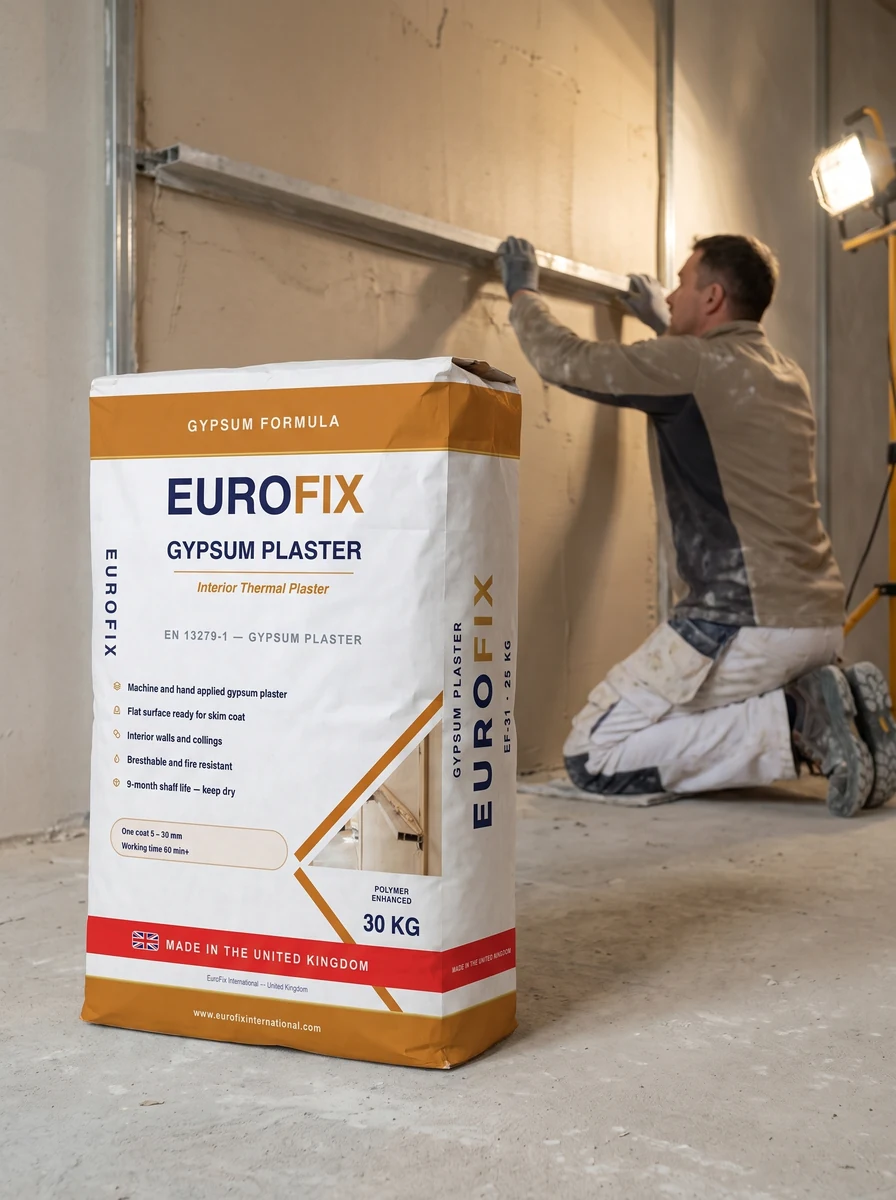
If your plastering is still a man on a scaffold with a hawk and trowel, you are paying for three things at once: longer programmes, a mix that drifts hourly, and a skim coat afterwards.
Machine plastering answers all three with one machine.
How the station works
A plastering station runs continuously rather than batch by batch: dry mix is fed into the hopper (or from a silo on larger jobs), the machine meters the water itself, a mixing screw kneads and drives the material, and it is pumped through a hose to a spray gun and thrown onto the wall. The plasterer then rules off, levels, and — if a paint-ready face is wanted — polishes with water.
Three real advantages, not one
Output. A manual plasterer spends most of the day mixing and carrying, not plastering. The station removes both, so the crew's time goes on the wall.
Consistency. This matters more than speed and gets noticed least. Hand mixing judges water by eye, and it drifts between workers and across the day; excess water weakens the coat and increases shrinkage. Metered water means the whole wall has one strength, instead of strong at the bottom and weak at the top.
Adhesion. Material is thrown rather than laid, so it keys into the surface and drives trapped air out. Fewer voids behind the coat — and voids are what make a wall sound hollow and flake later.
The argument that convinces the client: no skim
Machine gypsum polished with water inside its working window gives a surface ready for paint without a full skim coat. That removes an entire stage — its material, its labour, its days, its sanding dust — which often covers the cost of hiring the station on its own.
The condition is timing. Gypsum's window is narrow: too early and you drag the material, too late and it will not respond. That is learned by repetition, not by reading.
Comparison
| Item | Hand plastering | Machine plastering |
|---|---|---|
| Mixing | By hand, judged by eye | Metered, continuous |
| Water ratio | Drifts by worker and hour | Constant through the shift |
| Application | Laid on with a trowel | Sprayed under pressure |
| Voids behind the coat | Possible | Clearly fewer |
| Output | The baseline | Several times it |
| Skim coat | Normally required | Can be dropped by polishing |
| Crew size | Larger | Smaller for the same area |
| Site needs | Water and labour | Three-phase power, steady water pressure |
Where it fails
Most stations need three-phase power, so an unreliable site means a generator costed from day one. Fluctuating water pressure means a fluctuating water ratio, which defeats the reason for using the machine. Small scattered rooms do not justify setup and washout time. Gypsum left to set inside a hose ruins the hose — cleaning discipline is part of the technique, not an extra. And use a mix specified for machine application; a hand mix can block the hose or give an unworkable set time.
Prepare the surface first
A machine does not fix a bad substrate, it executes the mistake faster. Absorbent substrates take a stabilising primer; smooth non-absorbent concrete takes a quartz-loaded bonding primer. See our guide to primers and bonding coats.
As a business
There is a great deal of finishing work in Syria and a limited number of crews who can commit to a date. A machine-plastering contractor sells two things others cannot: a date that holds, because output is calculated rather than hoped for, and a paint-ready wall, which removes a whole stage from the client's programme.
You need the station, hoses and gun, a generator if the site demands it, a water tank and pump, and two or three people trained specifically on polish timing. We publish no machine prices or payback periods — they move with the model, the exchange rate and your workload. Send us the project and we will work it out on today's figures.