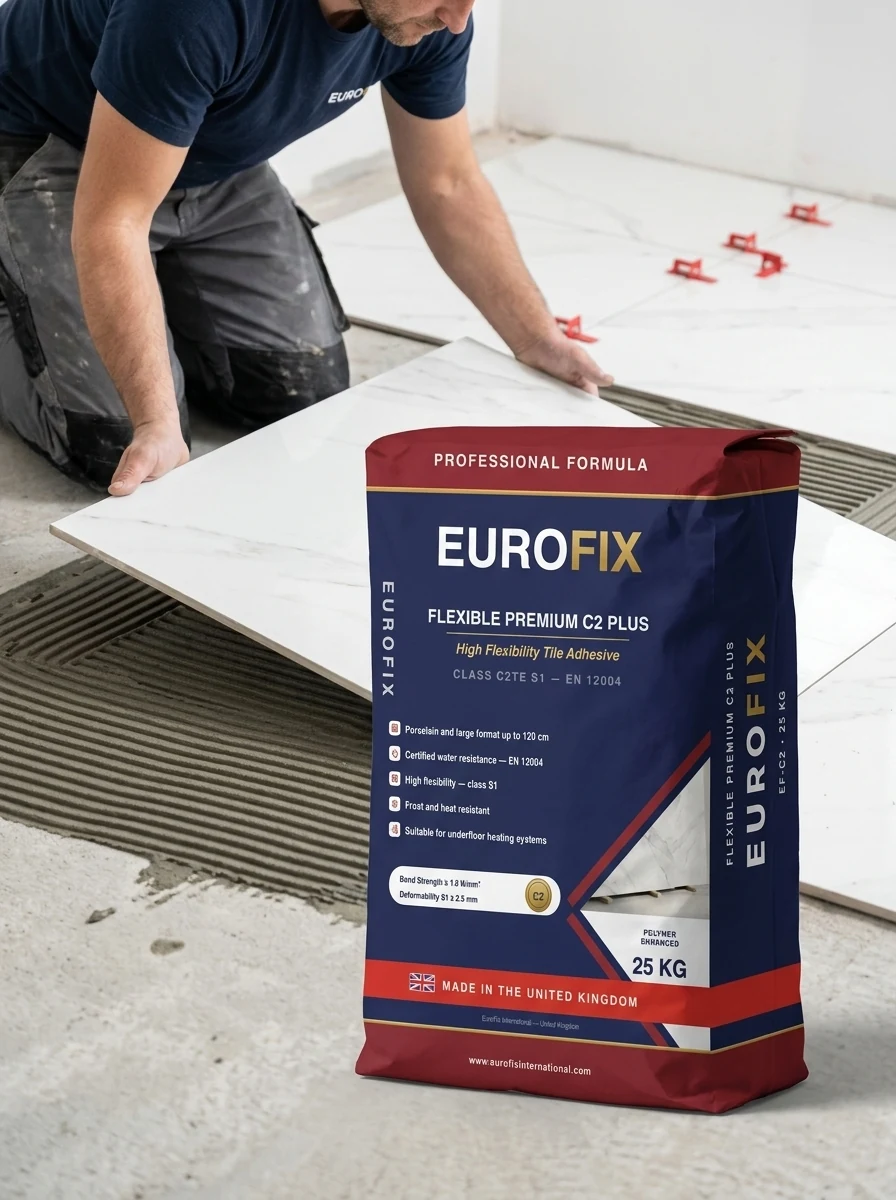
A question heard on every site: "the sand-cement mix is cheaper, so why an adhesive?" The answer is not price but how each one grips the tile — and that changed fundamentally when porcelain and large formats reached the Syrian market.
First: how does a sand-cement bed grip at all?
It relies on mechanical keying: the tile draws a little water from the mortar through its pores, cement crystals interlock inside those pores, and the bond forms.
That works for older ceramic absorbing 6–10% of its weight in water. Porcelain absorbs under 0.5% — its back is effectively smooth and closed. The mortar has nothing to key into, so it sits on the surface rather than in it.
A factory adhesive solves this differently: redispersible polymers (RDP) form a chemical bonding bridge across a smooth back, needing no absorption at all.
Second: the large-format problem
A 60×120 cm tile has six times the area of a 30×30. Three things scale with it:
- Warpage: every large tile has a slight bow. A thick bed hides it — but leaves voids under the centre.
- Thermal movement: a larger tile expands and contracts more. A rigid bed cannot absorb that, so stress goes into the bond. This is exactly what the S1 deformable class is for.
- Weight the bond must hold until it sets.
A void is not cosmetic: it is where moisture collects and where the tile cracks under point load — a furniture leg, a heavy step. Hence the requirement of at least 90% coverage in critical areas, and double-buttering outdoors and in pools.
Third: weight — the figure nobody adds up
A traditional bed is 15–25 mm thick; an adhesive is 3–6 mm. Across 100 m²:
- 20 mm bed: ≈ 36 kg/m² → 3,600 kg
- 4 mm adhesive: ≈ 6 kg/m² → 600 kg
Three tonnes less dead load per 100 m². Across several floors that is structural, and it matters most in renovation, where the frame already exists and cannot be added to.
Fourth: the real cost per m²
The fair comparison is not the price of a bag but the cost of a finished square metre: material, labour time, consistency, waste and — decisively — the probability of rework. Re-laying one square metre costs the tile, the labour, the demolition and the disposal, which usually exceeds the adhesive premium for the whole area. A contractor who prices the bag alone wins the tender and loses on the warranty.
Fifth: when is a sand-cement bed genuinely fine?
- Acceptable: absorbent interior ceramic up to 30×30 on a dry, level interior floor.
- Not suitable: porcelain of any size · any tile over 40 cm · façades · bathrooms and wet areas · pools · over underfloor heating · on gypsum or smooth substrates.
The practical rule
Ask three questions: what is the tile's absorption? what is its longest side? is the surface exposed to water or thermal movement? If the answer is "porcelain", "over 40 cm", or "yes", the traditional bed is a losing choice however cheap it looks.
Compare classes and consumption in tile adhesives, or read the difference between C1, C2 and S1.